


Instructor-led live Business Analysis training courses, whether delivered online or onsite, show through interactive discussion and practical exercises how to perform effective business analysis.
Business Analysis training is offered as "online live training" or "onsite live training". Online live training (also known as "remote live training") is conducted via an interactive remote desktop. Onsite live training can take place locally at the client's premises in Leiden or at NobleProg corporate training centers in Leiden.
NobleProg -- Your Local Training Provider
Leiden
Golden Tulip/Tulip Inn Leiden Centre, Schipholweg 3, Leiden, Netherlands, 2316XB
The 4-star Golden Tulip Leiden Center is located right next to the Tulip Inn Leiden Center hotel; together they accommodate 7 stars under one roof. The hotels are ideally located with Leiden Central Station directly opposite and many motorways within easy reach. A beautiful location in the center of the historic city of Leiden full of museums and picturesque spots. Experience, enjoy and be inspired.
Golden Tulip & Tulip Inn Leiden Center have a large diversity of hotel rooms; from comfortable and modern furnished standard rooms to luxurious executive rooms. In total there are 155 rooms. Furthermore, the hotels have a renovated restaurant called "Rubens", a cozy bar / lounge and an extensive meeting & conference center.
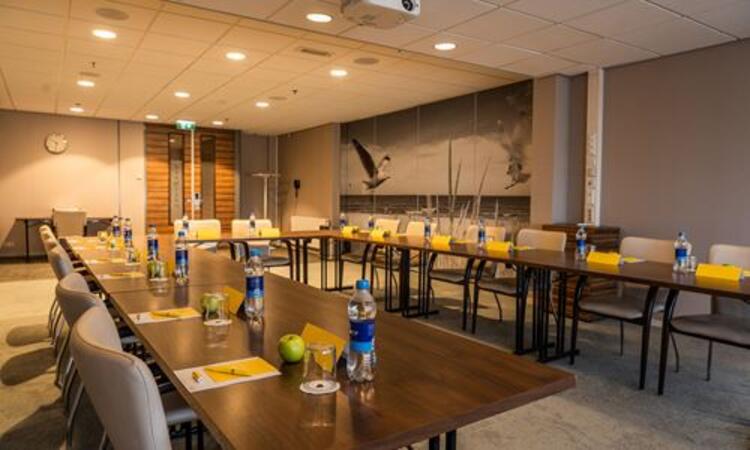
The 6 multifunctional rooms make Golden Tulip & Tulip Inn Leiden Center the ideal location for small and medium-sized meetings. The rooms have a capacity of 4 to 100 people. The meeting rooms offer countless possibilities in terms of setup and technical facilities. Convenience, efficiency, hospitality and professionalism are paramount. All rooms have air conditioning, free wireless internet and daylight.

Until the early 19th century, fishing in Noordwijk aan Zee remained the most important form of income. Later the population started to focus more and more on tourism. More than 1 million overnight stays take place every year. Noordwijk aan Zee consists of several districts and is located on the dunes. There are various catering establishments such as hotels, entertainment centers and restaurants (also on the beach) and there is a shopping center that has a Sunday opening. Every year events take place on the boulevard around the lighthouse on the Vuurtorenplein. The municipality has a KNRM rescue station and a reformed church (1647) with pulpit from the 17th century.
Since the merger with the Noordwijkerhout municipality, the municipality consists of four centers.
Noordwijk aan Zee, traditionally a fishing village, has become a seaside resort with a long coastal strip of approximately 13 km. . Noordwijk aan Zee has two boulevards, both of which are named after a queen, Queen Wilhelmina Boulevard and Queen Astrid Boulevard.
Noordwijk-Binnen radiates the tranquility of earlier centuries in the old core. In 1992 the old village center was designated as a protected village view under the Monuments Act.
Noordwijkerhout, a village and former municipality northeast of Noordwijk..Noordwijk aan Zee is rated as the 12th richest location in the Netherlands. Beer magnate Freddy Heineken has built a villa there with the characteristic green roof.
The Two Brothers Noordwijk Beach Hotel is located on the boulevard of Noordwijk with a view of the village and the sea and has several conference rooms and training rooms that make it the perfect place for business meetings and stimulating training. Noordwijk is a 30-minute drive from Amsterdam and The Hague and only 20 minutes from Leiden.
Cost-effectiveness analysis (CEA) is a structured approach to evaluating alternatives by examining the relationship between resources used and outcomes achieved.
This instructor-led live training, available online or onsite, is designed for intermediate-level professionals who want to apply cost-effectiveness methods to support informed, rational, and evidence-based decision-making across various sectors.
By the end of this course, participants will be able to:
Define cost-effectiveness questions and establish evaluation criteria.
Identify, classify, and quantify relevant costs and outcomes for diverse scenarios.
Apply analytical frameworks to compare alternatives using cost-effectiveness ratios.
Assess uncertainty, validate assumptions, and clearly communicate evaluation results.
Course Format
Facilitated presentations supported by real-world examples.
Practical exercises to reinforce analytical techniques.
Interactive problem-solving in a guided workshop environment.
Customization Options
Customized versions of this training are available upon request.
Business Analysis constitutes the discipline dedicated to uncovering organizational needs and devising solutions through the systematic collection, documentation, and improvement of processes.
This instructor-led live training, available either online or on-site, targets entry-level business analysts and project stakeholders who aim to grasp the BA function and develop practical competencies aligned with industry best practices.
Upon completion of this training, participants will be able to:
Comprehend the duties and competencies associated with a Business Analyst role.
Implement principles governing the Software Development Life Cycle (SDLC).
Leverage BABOK as a structural framework for analytical tasks.
Effectively document both functional and non-functional requirements.
Employ core techniques for eliciting requirements from stakeholders.
Course Format
Interactive lectures and discussions.
Practical application of BA tools and documentation templates.
Instructor-guided exercises centered on realistic analysis scenarios.
Customization Options
To arrange a tailored version of this course adapted to your specific industry or projects, please contact us.
This practical course on Modeling and Documentation for Business Analysis concentrates on the standard modeling languages and tools essential for capturing, visualizing, and validating business requirements and processes.
Designed as an instructor-led live training (available online or onsite), it targets professionals with little to no modeling experience who want to apply industry-standard techniques—such as UML, BPMN, and wireframing tools—to enhance clarity and communication within business analysis projects.
Upon completion of this training, participants will be able to:
Leverage UML diagrams to represent functional requirements and system behavior.
Model business processes in accordance with BPMN standards.
Develop clear and structured use case diagrams and accompanying documentation.
Design wireframes and interactive prototypes using Figma and Balsamiq.
Course Format
Interactive lectures and discussions.
Practical application of modeling tools within sample project scenarios.
Guided exercises focusing on process, requirements, and UI modeling.
Customization Options
If you wish to request customized training tailored to your organization’s standards or preferred toolset, please contact us to make arrangements.
Insurance in the Digital Era provides a practical overview of how digital transformation is reshaping products, operations, and customer engagement within the insurance sector.
This instructor-led live training (available online or onsite) is designed for intermediate-level insurance professionals who aim to understand and apply digital technologies, data-driven strategies, and innovation frameworks to modernize their insurance offerings and operational processes.
Upon completion of this training, participants will be able to:
Explain the role of AI, Big Data, IoT, and automation in modern insurance workflows.
Identify InsurTech trends and understand their impact on the insurance ecosystem.
Design customer-centric strategies enabled by digital tools and data insights.
Apply data-driven approaches to risk management and decision-making.
Develop an innovation and change management approach suitable for insurers.
Assess real-world case studies and translate lessons into local initiatives.
Format of the Course
Interactive lecture and discussion.
Case study analysis and group workshops.
Practical exercises and action planning for participants’ organizations.
Course Customization Options
To request a customized training for this course, please contact us to arrange.
Requirements Engineering (RE) serves as a fundamental discipline in software and systems development, concentrating on identifying, documenting, and managing stakeholder needs and constraints to guarantee project success.
This instructor-led, live training session, available online or onsite, is designed for intermediate-level professionals looking to deepen their grasp of practical Requirements Engineering while preparing for the IREB CPRE – Foundation Level certification exam.
Upon completing this training, participants will be capable of:
Understanding and applying the core concepts and terminology outlined in the IREB CPRE Foundation syllabus.
Identifying and eliciting requirements using effective and context-appropriate techniques.
Modeling, documenting, and validating requirements for real-world projects.
Managing requirements changes, traceability, and prioritization throughout the project lifecycle.
Leveraging Requirements Engineering tools and best practices to improve communication and project outcomes.
Being fully prepared to take and pass the IREB CPRE – Foundation Level certification exam.
Format of the Course
Interactive lecture and discussion.
Case-based exercises and collaborative workshops.
Exam preparation sessions and practice questions.
Course Customization Options
Additional modules or industry-specific case studies can be added on request.
This instructor-led, live training in Leiden (online or onsite) is aimed at business professionals who wish to learn intermediate-level skills for managing organizational charts using OrgPlus 6.
By the end of this training, participants will be able to:
Handle large data sets with sophisticated formatting tools.
Create data visualization reports and directories.
Use OrgPlus printing, exporting, and publishing features.
This course is designed for business analysts looking to apply BPMN 2.0 extensively within their projects.
The curriculum emphasizes the practical application of the entire BPMN 2.0 specification, along with the implementation of standard process patterns.
Through a blend of concise lectures and hands-on exercises, participants will be presented with business problems described in English. They will then be tasked with creating appropriate diagrams to address each scenario. Following this, the diagrams will be reviewed and evaluated by both the peers and the instructor.
Please note that this course does not cover the execution aspects of BPMN; instead, it concentrates on the analysis and process design components of BPMN 2.0.
Business analysis is the process of researching, understanding, and defining business needs to develop solutions that meet those needs. It is a key element in organizational change management and designing new business solutions. Business analysis aims to ensure that technological, process-related, or organizational solutions fulfill business goals and needs. It plays a crucial role in ensuring project effectiveness and organizational change by ensuring that implemented solutions are accurate, feasible, and fully aligned with business requirements.
Designed for seasoned Business Analysts, Product Owners, and User Researchers, this workshop focuses on mastering advanced techniques that generate tangible business value. Through practical exercises and real-world tools, participants will develop the ability to analyze intricate data, streamline processes, effectively engage stakeholders, and translate strategic goals into actionable outcomes using OKRs. Upon completion, attendees will possess a robust toolkit to enhance their impact and deliver measurable results.
This course emphasizes the role of the business analyst in ensuring success within Agile projects. Participants will learn how to collaborate effectively with the Development Team, Product Owner, Scrum Master, and Customer to facilitate the development process. Through a simulated project, attendees will practice handling common scenarios.
This instructor-led, live training in Leiden (online or onsite) is aimed at beginner-level / intermediate-level / advanced-level individuals who wish to use generative AI tools to support the daily work of a business analyst, including analysis, documentation, information structuring, and stakeholder communication.
By the end of this training, participants will be able to:
Understand the real capabilities and limitations of GenAI models (e.g., hallucinations, context windows).
Be able to use AI as an advanced tool supporting thought and analytical processes.
Learn how to create precise requirement structures and technical documents using AI.
Accelerate conceptual work, from hypothesis generation to documentation drafting.
Consciously evaluate the quality and substantive correctness of AI-generated outputs.
Gain knowledge on the safe and ethical use of AI tools concerning corporate data
This instructor-led, live training in Leiden (online or onsite) is aimed at beginner, intermediate, and advanced individuals who wish to integrate Strategic Agility and Quality Assurance, ensuring that quality becomes a catalyst for strategy rather than a hurdle, and that agility is grounded in repeatable, high-quality processes.
In modern business, organizations often face a "Trade-off Paradox": the faster they try to adapt to market changes, the more their quality standards tend to slip. Conversely, rigid quality processes often slow down innovation.
Strategic Agility addresses the problem of organizational "inertia"—the inability to react to environmental volatility. Quality Assurance addresses the risks of "process decay" during rapid scaling or pivoting.
By the end of this training, participants will be able to:
Business analysts bridge the gap between business challenges and IT solutions by designing information systems that operationalise corporate strategy. These technical solutions typically aim to achieve specific organisational goals: introducing a new business process, enhancing the efficiency and productivity of current processes, or reducing operational expenses.
This programme is designed for Business Analysts, particularly those aiming to pursue IIBA certifications (CCBA or CBAP). The curriculum aligns with the framework established in BABOK® Version 3.0.
Objectives:
Recognise the essential principles, activities, tasks, and techniques detailed in the BABOK® V3.0
Grasp the core knowledge areas, associated activities, deliverables, and their interrelationships:
Key Definitions:
BABOK® (Business Analysis Body of Knowledge): The standard guide for business analysis practice, serving as a comprehensive framework outlining the required tasks.
CCBA® (Certification of Competency in Business Analysis): A credential provided by the International Institute of Business Analysis (IIBA). Candidates must pass a BABOK®-based exam after their application, which is evaluated based on education and experience, has been approved.
CBAP® (Certified Business Analysis Professional): A professional designation offered by the International Institute of Business Analysis (IIBA). Similar to the CCBA®, it requires passing a BABOK®-based test following application approval based on educational and experiential criteria.
Gain mastery in the core principles of Business Analysis through practical training focused on requirements elicitation, process modeling, and stakeholder engagement. Designed for aspiring and junior analysts, this course provides essential BA competencies, insights into Agile/SDLC frameworks, and real-world case studies. Empower project success and deliver quantifiable business value. Advance your career with industry-relevant BA training.
Chief Executives (CxO), Operations Managers, Enterprise Architects, Business Analysts, System Analysts, Designers
Learning Objectives
This introductory seminar offers a comprehensive overview of digital business models, alongside the enterprise architecture frameworks and methodologies that organizations are increasingly adopting to enhance their agility amidst the disruptions characteristic of the digital era.
Specifically, this course is designed to help you grasp the frameworks and reference architectures utilized globally to align digital business models with IT system architectures, ensuring they remain synchronized with a shifting competitive landscape.
This course is designed for professionals responsible for creating process models using BPMN 2.0.
The curriculum emphasises the practical application of the entire BPMN 2.0 specification, alongside real-world implementations of common patterns.
Consisting of concise lectures followed by hands-on exercises, participants will be presented with problem scenarios and tasked with designing appropriate diagrams. These diagrams are then reviewed and evaluated through group discussion and trainer feedback.
The course aims to deepen understanding of BPMN diagrams while also introducing the fundamental execution mechanics associated with BPMN.
Business and systems analysts address organizational challenges by designing information systems that operationalize the strategies established by the business. Typically, these IT solutions aim to achieve one or more of the following objectives: implementing a new or innovative business process, enhancing the efficiency and productivity of current processes, or reducing the operational costs associated with existing workflows.
This course is designed for individuals transitioning into the field of Business Analysis. Upon fulfilling any prerequisites, participants may wish to pursue the CBAP certification examination offered by IIBA (www.iiba.org).
Who should attend?
Entry-level IT Business Analysts
Self-taught IT Business Analysts seeking to consolidate their knowledge and understand how various components integrate
Systems Analysts and programmers looking to expand their expertise into the business domain
This instructor-led, live training in Leiden (online or onsite) is aimed at beginner-level / intermediate-level / advanced-level individuals who wish to develop skills in business and process modeling for a better understanding of the organization, products, and dependencies between processes, data, and stakeholders.
By the end of this training, participants will be able to:
Understand the role of models as key communication tools in business analysis.
Be able to select the right modeling method (BPMN, UML, SIPOC, Business Model Canvas) for a specific business goal.
Know how to decompose complex business processes into clear diagrams.
Identify touchpoints between processes, data, and system actors.
Be able to assess the correctness and effectiveness of created business models.
This instructor-led, live training in Leiden (online or onsite) is designed for beginner-level, intermediate-level, and advanced-level individuals who wish to prepare to effectively plan, lead, and support organizational changes, taking into account human, communication, and process factors.
By the end of this training, participants will be able to:
Understand the psychological and structural mechanisms of organizational change.
Independently plan comprehensive Change Management activities.
Identify risks and diagnose sources of resistance to change.
Actively support stakeholders at every stage of the transition process.
Apply professional communication tools tailored to various audience groups.
This instructor-led, live training delivered in Leiden (either online or onsite) is designed for beginners to intermediate-level professionals who wish to develop skills in conscious data analysis. The course aims to teach participants how to translate analytical results into business conclusions and recommendations that support both operational and strategic decisions.
Upon completion of this training, participants will be able to:
Understand the role of data in modern decision-making processes.
Assess data quality and its business relevance.
Apply intermediate data analysis techniques (trends, segmentation, scenario analysis).
Differentiate between correlation and causation when interpreting results.
Formulate precise, evidence-based insights and recommendations.
Effectively communicate complex analytical findings to decision-makers.
Proven design patterns are widely accessible. Implementing them often involves adapting existing concepts to specific technologies, which can save hundreds of hours that would otherwise be dedicated to design and testing phases. Course Objectives This training programme has two main objectives: first, it enables you to leverage well-established patterns, and second, it empowers you to develop and reuse patterns tailored to your organization’s needs. It helps you estimate how patterns can reduce costs, systematize the design process, and generate a code framework based on your specific patterns. Audience This course is suitable for software designers, business analysts, project managers, programmers, developers, operational managers, and heads of software divisions. Course Approach The training focuses on use cases and their relationship with specific patterns. Most examples are explained using UML and simple Java code (the language may change if the course is booked as a private session). It guides you through the origins of patterns and shows you how to catalogue and describe patterns for reuse across your organization.
This foundational course caters to professionals engaged in Requirements Engineering and Agile methodologies. It is designed for roles including project or IT management, domain experts, system analysts, software developers, Scrum Masters, Product Owners, and members of Agile-oriented organizations.
RE@Agile draws inspiration from both IREB’s perspective on Agile values and an Agile interpretation of Requirements Engineering values. The curriculum covers the classification and evaluation of Requirements Engineering work products and techniques within an Agile context, as well as Agile work products and techniques within Requirements Engineering. It also addresses essential process elements in Agile product development and highlights the rationale for adopting Agile approaches in development processes.
A key focus is the synergy between Requirements Engineering and Agile: exploring Agile principles related to Requirements Engineering and the Agile mindset in relation to core Requirements Engineering values.
The Examination
This course serves as the preparation for the RE@Agile Primer examination. Two examination options are available:
A proctored multiple-choice exam leading to the official RE@Agile Primer certificate, comparable in format to the CPRE Foundation and Advanced Level exams, but with a duration of 40 minutes.
An online multiple-choice self-assessment with a confirmation of participation.
This Advanced Level Module, RE@Agile, is designed for Requirements Engineers and agile professionals. It concentrates on understanding and implementing practices and techniques from the Requirements Engineering discipline within agile development processes. Additionally, it covers the comprehension and application of concepts, techniques, and essential process elements of agile approaches in Requirements Engineering workflows.
The Examination
This course prepares participants for the Advanced Level certification exams under:
RE@Agile - Practitioner (certificate awarded upon passing a multiple-choice exam)
RE@Agile - Specialist (certificate awarded upon successful completion of a written assignment)
This three-day course is conducted as a live, instructor-led session, available either online (remote) or onsite (classroom).
Who is this course for:
The Advanced Requirements Management course is designed for professionals in the fields of requirements engineering, business analysis, business engineering, organizational design, and related disciplines who wish to deepen their knowledge and skills in requirements management.
Examination:
Additional exam fees may apply where applicable.
The “IREB Certified Professional for Requirements Engineering – Advanced Level (Management)” exam comprises the following options:
CPRE Advanced Level (Management) – Practitioner
The exam to achieve the Requirements Management - Practitioner - certificate
consists of a multiple-choice exam.
CPRE Advanced Level (Management) – Specialist
The exam to achieve the Requirements Management - Specialist - certificate consists of
a written assignment.
This course is offered in a live, instructor-led format, available either online (remote) or onsite (in a classroom setting).
The Certified Professional for Requirements Engineering (CPRE) certification targets professionals working in Requirements Engineering, Business Analysis, and Testing. The curriculum covers the core principles of the Requirements Engineering domain, along with relevant methodologies and techniques.
The certification framework is established by the IREB, and candidates may sit for the CPRE exam through approved certification bodies.
Who is this course for?
This course is designed for anyone involved in Requirements Engineering, Business Analysis, or software and systems development. The Foundation Level module addresses key areas such as eliciting requirements and documenting them appropriately, verifying and validating requirements, and managing them throughout the entire product lifecycle.
By the end of this training, participants will be able to:
Understand the terminology associated with Requirements Engineering, Business Analysis, and Requirements Management.
Grasp the fundamental techniques and methods of Requirements Engineering and their practical application.
Become familiar with widely accepted notations for specifying requirements.
This instructor-led, live training in the Netherlands (online or onsite) is aimed at beginner-level / intermediate-level / advanced-level individuals who wish to focus on the Financial Sector andIT Industry. We move beyond simple definitions to explore how heavy regulations and risk management frameworks dictate the pace of innovation and operational decision-making. We analyze the mechanics of software delivery, the shift from legacy models to SaaS, and the critical challenges of scalability and security. We conclude by defining the evolving role of the Consultant and Analyst as a strategic bridge between business goals and technical execution.
By the end of this training, participants will transition from being "service providers" to "trusted advisors" who can anticipate industry shifts and propose solutions that resonate with the client’s specific strategic reality.
This live, instructor-led training in Leiden (online or onsite) is designed for business professionals and data analysts with intermediate Python skills who wish to use Python to automate workflows, analyze business data, and generate dynamic Excel-based reports.
This instructor-led live training, available Leiden (online or onsite), is designed for individuals aiming to understand requirements analysis and execute it efficiently using targeted analytical techniques.
By the end of this session, participants will be able to:
Identify different types of requirements.
Understand the overarching concepts and activities within requirements analysis.
Become familiar with requirements analysis methodologies.
Utilize various requirements analysis techniques to enhance project outcomes.
Structure requirements to ensure clear and efficient communication with architects and developers through an iterative gathering process.
This instructor-led, live training in Leiden (online or onsite) is aimed at beginner-level / intermediate-level / advanced-level individuals who wish to use comprehensive program designed to bridge the gap between identifying organizational challenges and implementing secure, data-driven solutions. This instructor-led, live training (online or onsite) is aimed at beginner-level / intermediate-level / advanced-level individuals who wish to use focus on analytical precision: moving beyond surface-level symptoms to find the root causes of business issues and structuring them for clear decision-making. Strategic foresight, teaching participants how to quantify uncertainty through formal risk assessment, evaluate potential impacts, and develop robust response strategies
By the end of the course, participants will have a toolkit for transforming vague business obstacles into actionable, de-risked project plans.
This instructor-led, live training in Leiden (available online or onsite) is designed for beginner, intermediate, and advanced levels, addressing the challenge of transforming passive or resistant observers into active, supportive partners through systematic analysis and psychological insight.
In complex business environments, project success rarely depends on technical execution alone; it hinges on the support of the people involved. The primary challenge in Stakeholder Management is navigating the "web of influence"—understanding that different parties hold competing priorities, varying levels of power, and subjective definitions of success. Without proactive management, projects often encounter "hidden blockers," sudden shifts in support, or communication breakdowns.
Upon completion of this training, participants will be able to:
Managers seeking to comprehend BPMN diagrams, Business Consultants, Business Analysts, Business Process Engineers, System Analysts, and all professionals engaged in analyzing and planning business processes using standardized, unified modeling notation.
Course Objectives:
Create high-quality process diagrams
Model processes using BPMN notation
Document current-state process information
Implement optimized process flows for people-centric processes
Simplify complex process definitions and decompose them into more manageable components
Read more...
Last Updated:
Testimonials (10)
the practical part
Daniela Mirevska
Course - Business Process Modelling in BPMN 2.0
The teacher clarification of the teacher about the subjects
Josildo Zangue - EMIS - Empresa Interbancaria de Servicos, S.A
Course - Business Analysis
What I like the most about the training was the detailed discussion and the Exercises.
Kevin Roi Rimpos - Century Pacific Food Inc.
Course - Business Process Re-engineering for Competitive Advantage
The trainer shared his knowledge and led great atmosphere.
Agnieszka Dubanska - Narodowy Fundusz Zdrowia
Course - Modelowanie procesów biznesowych z wykorzystaniem UML i BPMN
The explanations and interactivity of the trainer, he really brought the subject well; and even-though I was probably not experienced enough, I did learn a lot from it!
Pieter Bruynseels - Spot Buy Center BV
Course - Design Patterns
Richard is a great teacher
Federico - Circle spa
Course - BPMN 2.0 for Business Analysts
the lessons
Angela - PT Andalan Teknologi Bersama
Course - Introduction to Business Analysis: Defining Successful Projects
Friendly, plenty of breaks to think about what we have learnt and lovely guy.
Leanne - Welsh Revenue Authority
Course - Agile Business Analysis
the Trainer tailored the session to our organisation and help us understand what we could be improving on.
Christopher - Department of Training & Workforce Dev.
Course - BPMN 2.0 Fundamentals and Workshop
comparing theory to practical life
Olaf - Bank Millennium S.A.
Course - Business Analysis, BABOK V3.0 and IIBA Certification Preparation
Provisional Upcoming Courses (Contact Us For More Information)
Online Business Analysis training in Leiden, Business Analysis training courses in Leiden, Weekend Business Analysis courses in Leiden, Evening Business Analysis training in Leiden, Business Analysis instructor-led in Leiden, Business Analysis on-site in Leiden, Business Analysis coaching in Leiden, Evening Business Analysis courses in Leiden, Weekend Business Analysis training in Leiden, Business Analysis instructor in Leiden, Business Analysis one on one training in Leiden, Business Analysis classes in Leiden, Business Analysis private courses in Leiden, Business Analysis instructor-led in Leiden, Business Analysis trainer in Leiden, Online Business Analysis training in Leiden, Business Analysis boot camp in Leiden